

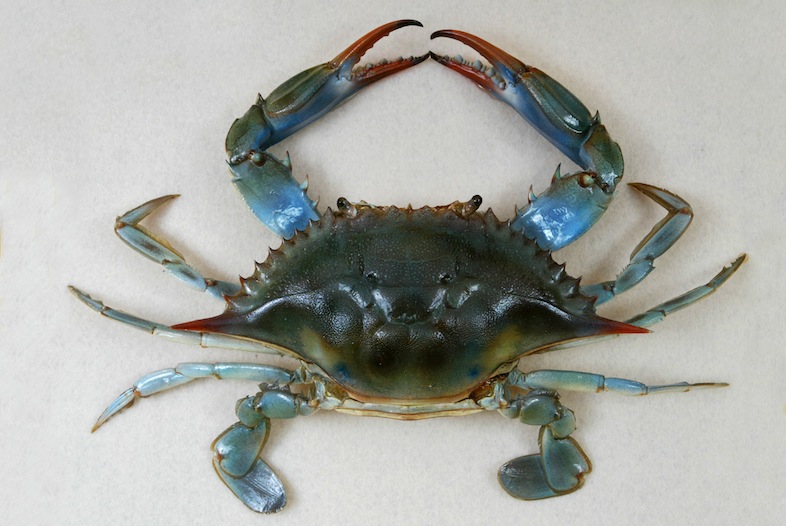
Callinectes sapidus is of considerable culinary and economic importance in the USA, particularly in Louisiana, North Carolina, the Chesapeake Bay, Delaware, and New Jersey. It is the Maryland state crustacean and the state's largest commercial fishery. However, due to overfishing and environmental pressures, some of the fisheries have had declining, especially in the Chesapeake Bay fishery
| Kingdom | Animalia |
| Phylum | Arthropoda |
| Subphylum | Crustacea |
| Class | Malacostraca |
| Order | Decapoda |
| Family | Portunidae |
| Genus | Callinectes |
| Species | C. sapidus |
Callinectes sapidus is a decapod crab of the swimming crab family Portunidae. The genus Callinectes is distinguished from other portunid crabs by the lack of an internal cartilaginous spine on the carpus (the middle segment of the claw), as well as by the T-shape of the male abdomen. Blue crabs may grow to a carapace width of 23 cm (9.1 in). C. sapidus individuals exhibit sexual dimorphism. Males and females are easily distinguished by the shape of the abdomen (known as the "apron") and by color differences in the chelipeds, or claws. The abdomen is long and slender in males, but wide and rounded in mature females. A popular mnemonic is that the male's apron is shaped like the Washington Monument, while the mature female's resembles the dome of the United States Capitol. Claw color differences are more subtle than apron shape. The immovable, fixed finger of the claws in males is blue with red tips, while females have orange coloration with purple tips. A female's abdomen changes as it matures: an immature female has a triangular-shaped abdomen, whereas a mature female's is rounded.
Other species of Callinectes may be easily confused with C. sapidus because of overlapping ranges and similar morphology. One species is the lesser blue crab ( C. similis). It is found further offshore than the common blue crab, and has a smoother granulated carapace. Males of the lesser blue crab also have mottled white coloration on the swimming legs, and females have areas of violet coloration on the internal surfaces of the claws.[9] C. sapidus can be distinguished from another related species found within its range, C. ornatus, by number of frontal teeth on the carapace. C. sapidus has four, while C. ornatus has six.
The crab's blue hue stems from a number of pigments in the shell, including alpha-crustacyanin, which interacts with a red pigment, astaxanthin, to form a greenish-blue coloration. When the crab is cooked, the alpha-crustacyanin breaks down, leaving only the astaxanthin, which turns the crab to a bright orange-red color.
Callinectes sapidus is native to the western edge of the Atlantic Ocean from Cape Cod to Argentina and around the entire coast of the Gulf of Mexico. It has recently been reported north of Cape Cod in the Gulf of Maine, potentially representing a range expansion due to climate change. It has been introduced (via ballast water) to Japanese and European waters, and has been observed in the Baltic, North, Mediterranean and Black Seas. The first record from European waters was made in 1901 at Rochefort, France. In some parts of its introduced range, C. sapidus has become the subject of crab fishery, including in Greece, where the local population may be decreasing as a result of overfishing
The natural predators of C. sapidus include eels, drum, striped bass, spot, trout, some sharks, humans, cownose rays, and whiptail stingrays. C. sapidus is an omnivore, eating both plants and animals. C. sapidus typically consumes thin-shelled bivalves, annelids, small fish, plants and nearly any other item it can find, including carrion, other C. sapidus individuals, and animal waste. C. sapidus may be able to control populations of the invasive green crab, Carcinus maenas; numbers of the two species are negatively correlated, and C. maenas is not found in the Chesapeake Bay, where C. sapidus is most frequent