

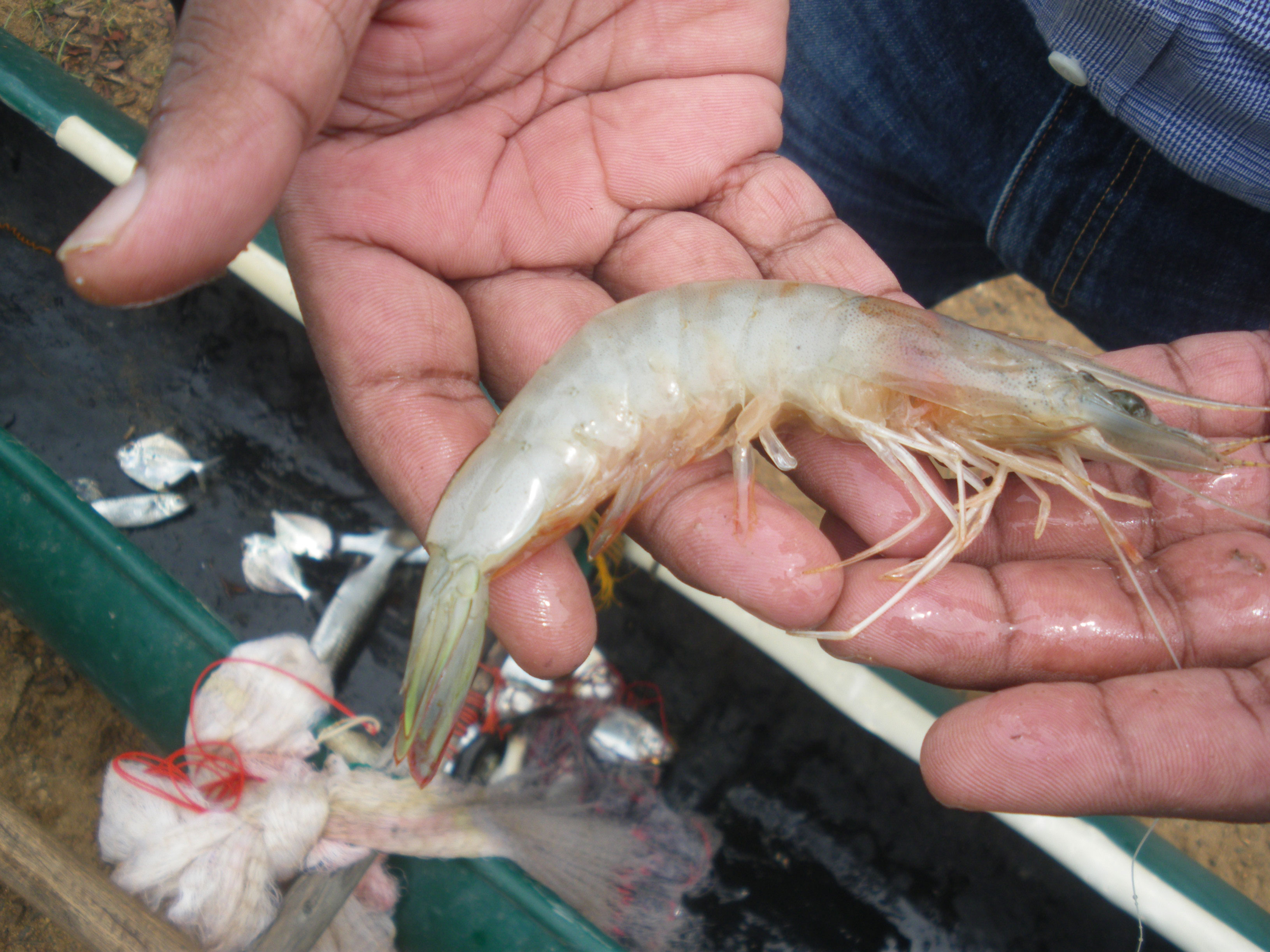
The Indian prawn (Fenneropenaeus indicus, formerly Penaeus indicus), is one of the major commercial prawn species of the world. It is found in the Indo-West Pacific from eastern and south-eastern Africa, through India, Malaysia and Indonesia to southern China and northern Australia. [3] Adult shrimp grow to a length of about 22 cm (9 in) and live on the seabed to depths of about 90 m (300 ft). The early developmental stages take place in the sea before the larvae move into estuaries. They return to the sea as sub-adults.
| Kingdom | Animalia |
| Phylum | Chordata |
| Subphylum | Crustacea |
| Class | Malacostraca |
| Order | Decapoda |
| Suborder | Dendrobranchiata |
| Family | Penaeidae |
| Genus | Fenneropenaeus |
| Species | F. indicus |
The world's production of shrimp is about 6 million tonnes, of which approximately 3.4 million tonnes is contributed by capture fisheries and 2.4 tonnes by aquaculture. China and four other Asian countries, including India, Indonesia, Vietnam and Thailand, together account for 55% of the capture fisheries. Among the shrimp, the contribution of F. indicus to global fisheries was around 2.4%, and to global farmed shrimp production was 1.2% in 2005. Currently F. indicus is mainly cultured in Saudi Arabia, Vietnam, Islamic Republic of Iran and India. Saudi Arabia was the largest producer in 2005 at nearly 11,300 tonnes with Vietnam not far behind with 10,000 tonnes. In India F. indicus farming declined from 5200 tonnes in 2000 to 1100 tonnes in 2005 due to preference of farmers for P. monodon.
In 2010, Greenpeace International added the Indian prawn to its seafood red list. Although the Indian prawn itself is not threatened, the methods used to capture it result in a large amount of bycatch, which includes endangered species such as sea turtles.
Production cycle of F. indicus follows the same steps as for other species of shrimp, i.e., seed production and Grow-out of the post larvae to marketable size. The sources of seeds and grow- out techniques can be differed as desired by the farmer to achieve a balance between the cost of production and the desired quantity of output.
Seeds can be obtained from the wild or by establishment of hatcheries. In traditional paddy field systems the juveniles which have congregated near the sluice gates are allowed to enter the field with the incoming high tide. Among the prawn species entering the field F. indicus constitute around 36%–43%. Earlier wild seeds were also collected and sold to shrimp farmers. Nowadays the dependence on wild seed has been reduced due to establishment of hatcheries and also due to reduction in wild seeds due to overfishing.
Intensification of cultured shrimp is limited by seed supply. The production of seeds in hatcheries depends on the availability of broodstock and quality of spawners. Spawners for seed production can be obtained from the wild or can be developed by induced maturation in hatcheries.
Matured individuals can be collected from the wild during their peak spawning seasons in March/April and July/August in the tropics. A temperature range of 27–31 °C (81–88 °F) and salinity of 30‰–35‰ is ideal for spawning.
Although hatcheries in the developing countries still depend on wild seed, maturation can be induced by eyestalk ablation technique where eyestalks of females are unilaterally ablated to stimulate endocrine activity. The ablated females spawn after 4 days, with a peak observed at days 5–6. However it is expensive to raise spawners in captivity and ablated shrimps result in less hardy fry with low survival rate. Even though the fecundity of the ablated females may not differ significantly, the hatch rates of ablated females was found to be markedly less (37.8% to 58.1%) than that of unablated females (69.2%). It is also found that wild females are more fecund per unit weight than ablated females. However quantitatively the number of spawns, eggs and nauplii produced by ablated females is ten, eight and six times respectively that of unablated females.
Circular tanks of 2–5 tonnes capacity are used to rear larvae from nauplius to mysis stage. The salinity of water is maintained at around 32‰ and pH at 8.2. Feed is not provided to nauplius as it is a non-feeding stage. The protozoea stage is supplied with a mixed culture of diatoms dominated by Chaetoceros spp. or Skeletonema spp. at a concentration on around 30,000 to 40,000 cells per ml. The best algal density promoting highest survival, growth and fastest larval development is around 60–70 cells per μl. From the mysis stage they are also fed with artemia nauplii and egg-prawn-custard mix. Post larval rearing can be continued in the same tank and post-larvae (PL) are fed with minced mussel meat, mantis shrimp powder or variety of other fresh feeds of particle size 200–1000 μm till they reach PL-20 (day 20 of post-larva). After PL-20 stage they can be stocked directly into grow-out ponds without acclimatization.