

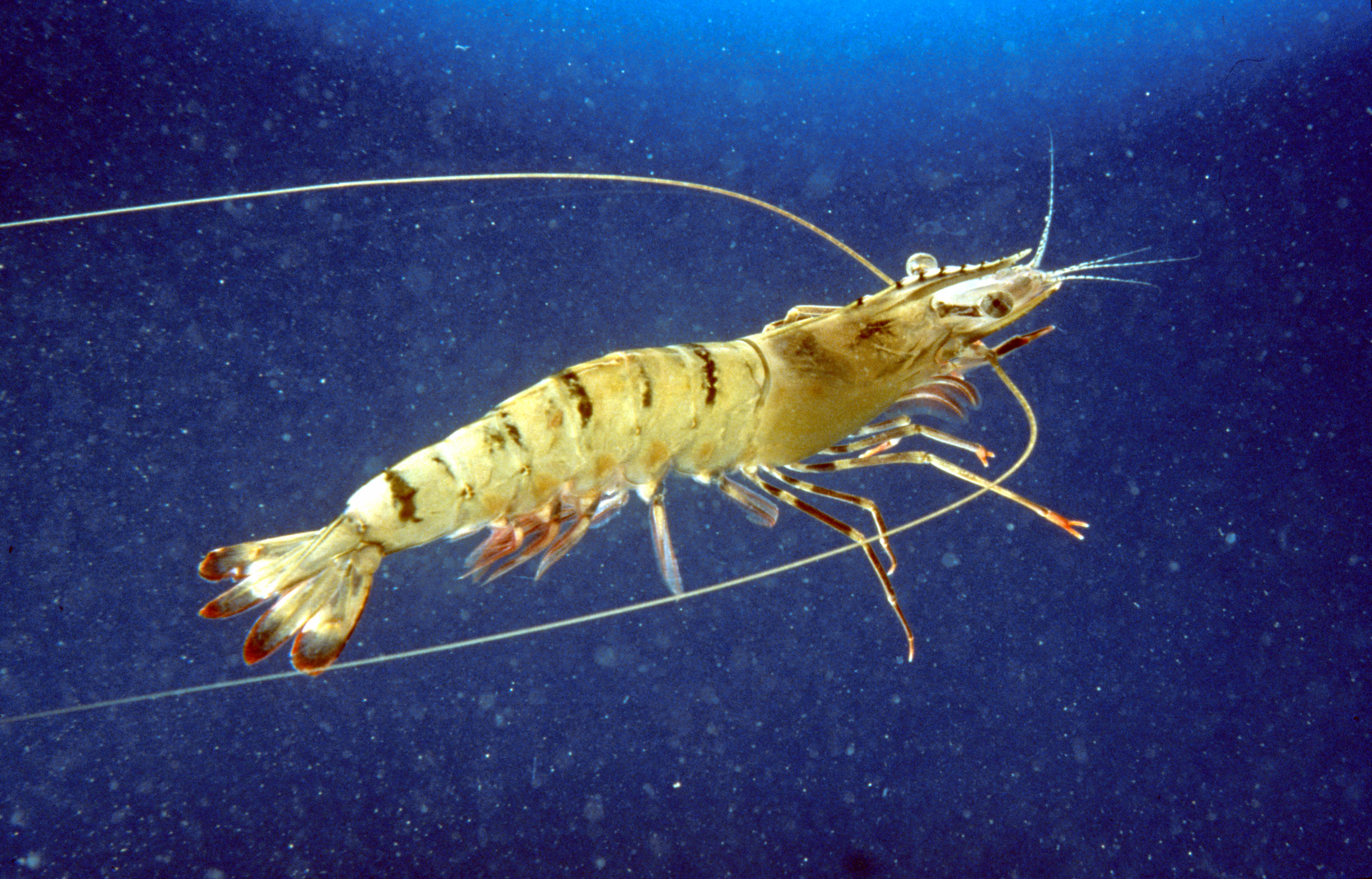
Penaeus monodon, commonly known as the giant tiger prawn, Asian tiger shrimp, black tiger shrimp, and other names, is a marine crustacean that is widely reared for food.
| Kingdom | Animalia |
| Phylum | Arthropoda |
| Subphylum | Crustacea |
| Class | Malacostraca |
| Order | Decapoda |
| Suborder | Dendrobranchiata |
| Family | Penaeidae |
| Genus | Penaeus |
| Species | P. monodon |
The first occurrence of P. monodon in the U.S. was in November 1988. Close to 300 shrimp were captured off the Southeastern shore after an accidental release from an aquaculture facility. This species can now be caught in waters from Texas to North Carolina. Although P. monodon has been an invasive species for many years, it has yet to grow large established populations.[11] Escapes in other parts of the world, though, have led to established P. monodon populations, such as off West Africa, Brazil, and the Caribbean.
P. monodon is suited to inhabit a multitude of environments.[14] They mainly occur in Southeastern Asia, but are widely found. Juveniles of P. monodon are generally found in sandy estuaries and mangroves, and upon adulthood, they move to deeper waters (0- 110 meters) and live on muddy or rocky bottoms. The P. monodon has shown to be nocturnal in the wild, burrowing into substrate during the day, and coming out at night to feed. P. monodon typically feed on detritus, polychaete worms, mollusks, and small crustaceans. They feed on algae, as well. Due to their nutrient-rich diet, these shrimp are unable to consume phytoplankton because of their feeding appendages, but they are able to consume senescent phytoplankton. They also commence mating at night, and can produce around 800,000 eggs.
The prawn is popular to culture because of its tolerance to salinity and very quick growth rate. However, they are very vulnerable to fungal, viral, and bacterial infections. Diseases such as white spot disease and yellowhead disease have led to a great economic impact in shrimp industries around the globe. They can receive transmitted diseases from other crustaceans such as the Australian red claw crayfish (Cherax quadricarinatus), which is susceptible to yellowhead disease and has shown to transmit it to P. monodon in Thailand.
Since black tiger shrimp are susceptible to many diseases, this engenders economic constraints towards the black tiger shrimp food industry in Australia, which is farm-raised. To confront such challenges, attempts have been made to selectively breed specific pathogen-resistant lines of black tiger shrimp.
P. monodon has been farmed throughout the world, including areas such as West Africa, Hawaii, Tahiti, and England. For optimal growth, P. monodon is raised in waters between 28 and 33°C. Characteristically for the Penaeus genus, P. monodon has a natural ability to survive and grow in a wide range of salinity, though its optimal salinity is around 15-25 ppt. While in a farm setting, the shrimp are typically fed a compound diet, which is produced in dried pellets. By mixing the diet to have compound feeds and fresh feed, P. monodon was shown to have better reproductive performance.